Plant Calculator
Enter the approximate length and width of the area you will be planting and click 'Calculate' to determine how many Monarda fistulosa 'Claire Grace' you will need.
Correct and successful spacing is complex and depends on project conditions. We encourage you to call us at 877-ECO-PLUG for project specific recommendations and further assistance.
Monarda fistulosa 'Claire Grace'
wild bergamot
- Category: Perennial, Native
- Hardiness Zone: 3-8
- Height: 3 Feet
- Spread: 2 Feet
- Spacing: 12-24 Inches
- Bloom Color: Pink
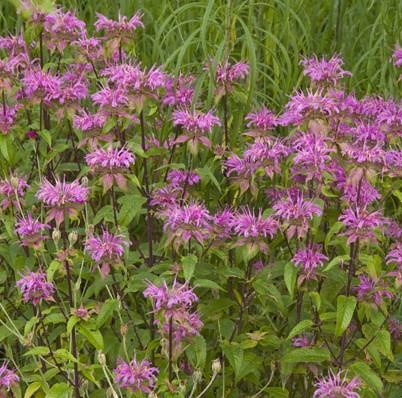
This great plant was named by Mike and Barbara Bridges, of Southern Perennials and Herbs, for their daughter. Soft lavender pin cushion-like flowers. Quite mildew resistant, with excellent, shiny foliage. Extremely showy. A must for the avid butterfly gardener!
Click here to download technical information for growers:

Green Infrastructure
| • | Green Roof |
Wetland Indicator Status
| • | Obligate Upland (UPL) |
Attributes
| • | Native to North America |
| • | Drought Tolerant |
| • | Clay Tolerance |
| • | Cut Flower |
| • | Edible |
| • | Fragrant |
Season of Interest (Flowering)
| • | Late Summer |
Propagation Type
| • | Vegetative |
Additional Information about Monarda fistulosa 'Claire Grace'
This great plant was named by Mike and Barbara Bridges, of Southern Perennials and Herbs, for their daughter. Monarda fistulosa 'Claire Grace' has soft lavender pincushion-like flowers, growing 3-4' tall and 2' wide. When in bloom, it is extremely showy and was covered in 100% flower coverage for over 3 weeks during the three-year-long Mt. Cuba Center Monarda trials. 'Claire Grace' is quite mildew resistant, with excellent shiny foliage. It is a must for the avid butterfly gardener and you'll see why as it blooms from June to July!
Monarda fistulosa can be found as far north as Quebec and Manitoba, spreading down south to Georgia, Louisiana, and Arizona. Beebalm prefers full sun to part sun in average to moist soil conditions. It grows rampantly in moist rich loam but can tolerate drier conditions. In moist conditions, the plant is known to flop so a good plant to plant around other perennials that can provide structure. In drier conditions, the bottom leaves of the stems fall off, which also can be supported and hidden by a layered planting design and strong, perennial neighbors with a different season of interest.
'Claire Grace' is known for its ability to tolerate both wetter and drier conditions. Wild bergamot is particularly wonderful when planted near a spot where one can observe its flowers, not just for the beautiful blooms but also the wildlife attraction and how the seedheads dance in the early morning light after a frost. All Monarda is deer and rabbit resistant due to its aromatic foliage that resembles the taste of oregano. It provides habitat and forage to a wide variety of pollinators including bees, butterflies, moths, and hummingbirds as well as some specialist insects.
Growing & Maintenance Tips for Monarda fistulosa 'Claire Grace'
Found naturally in rocky meadows, thickets and glade margins. Prefer dry to moist, organically rich, well-drained soil in full to part sun. More prolific in full sun. This species is more tolerant of drought and powdery mildew than others. Needs good air circulation. Has creeping rhizomes that usually form in clumps. Propagated by seed and division every 2-3 years. Best used in wild gardens or in naturalized areas.